
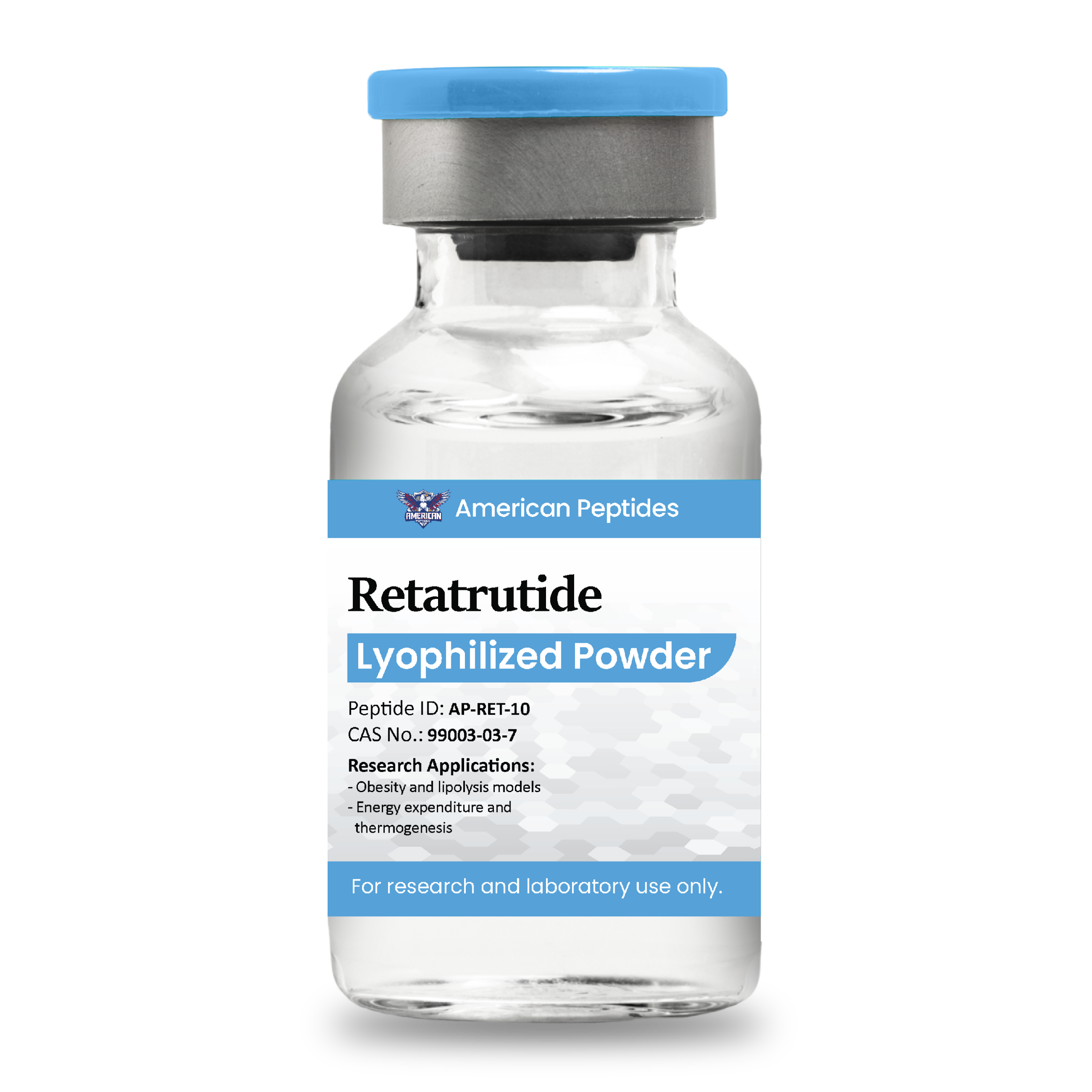

Retatrutide
Price range: $49.99 through $175.00
Retatrutide is a next-generation tri-agonist peptide that simultaneously targets GLP-1, GIP, and glucagon
receptors. As one of the most comprehensive metabolic modulators available for research, it is
revolutionizing the study of obesity, lipid metabolism, and energy homeostasis.
Retatrutide is a cutting-edge tri-agonist peptide designed to activate the GLP-1, GIP, and glucagon receptors. It represents a next-generation investigational tool for the study of obesity, insulin resistance, and advanced metabolic syndromes. By engaging three key incretin and glucoregulatory pathways, Retatrutide offers a powerful platform for researchers to study weight reduction, glycemic control, and energy balance across multiple mechanisms of action.
– Form: Lyophilized peptide
– Purity: ≥99%
– Origin: Manufactured and tested in the USA
– Certifications: Certificate of Analysis (COA) included with every order
Retatrutide acts as a potent tri-agonist for:
– GLP-1 Receptor: Enhances glucose-dependent insulin secretion and reduces appetite
– GIP Receptor: Supports insulin release and improves insulin sensitivity
– Glucagon Receptor: Increases energy expenditure and lipid metabolism
The combination of these actions promotes enhanced satiety, improved glycemic profiles, and sustained energy utilization, making it an advanced candidate for metabolic research.
– Tri-pathway incretin/glucagon signaling studies
– Advanced obesity and metabolic syndrome models
– Energy expenditure and thermogenesis
– Insulin resistance and lipid metabolism
– Novel anti-diabetic agent development
– Multi-receptor targeting for synergistic outcomes
– Investigational profile for next-gen weight management models
– Robust pharmacological data for translational studies
– Exceptional purity for experimental consistency
Each vial is:
– Manufactured in a GMP-compliant U.S. facility
– Accompanied by a Certificate of Analysis (COA)
– Subjected to HPLC and mass spectrometry verification
– Shipped from within the United States for quality control
– Contents: 5mg of lyophilized Retatrutide peptide
– Appearance: White/off-white powder
– Solubility: Sterile bacteriostatic water or acetic acid recommended
– Storage: Store lyophilized vial at -20°C; reconstituted solution stable up to 30 days when refrigerated
*For laboratory research use only. Not intended for human or veterinary use.*
Retatrutide is a novel triple hormone receptor agonist that targets GLP-1, GIP, and glucagon receptors. It is under investigation for its effects on glucose metabolism, energy expenditure, and body weight regulation.
Retatrutide activates GLP-1 and GIP receptors to enhance insulin secretion and reduce appetite, while glucagon receptor activation increases energy expenditure. This multi-pathway approach may yield synergistic metabolic effects in research models.
Retatrutide from Legion Peptides is available as a lyophilized powder in sterile vials for laboratory research use only. Each vial is synthesized and tested in the United States.
No. Retatrutide is strictly for laboratory research and is not intended for human or veterinary consumption.
Store lyophilized Retatrutide at -20°C in a dry, dark location. Once reconstituted, it should be refrigerated at 2–8°C and used promptly based on lab stability protocols.
All Retatrutide batches are >98% pure as confirmed by HPLC and Mass Spectrometry. Each purchase includes a certificate of analysis for quality assurance.
Yes. While our standard packaging ensures stability during transit, cold-chain shipping is available upon request for sensitive or bulk orders.
Some research protocols explore the use of Retatrutide in combination with other incretin-based therapies. All such studies must be conducted under appropriate lab protocols.
Go to our Lab Test Results page, choose Retatrutide from the dropdown, and enter your name and email to receive the Certificate of Analysis directly.
American Peptides provides U.S.-made, research-grade Retatrutide with fast shipping, transparent testing, and superior support. Every vial is backed by lab documentation and purity verification.
Retatrutide Dosage Protocol (5 mg, 10 mg, 20 mg, 30 mg Vials)
Quickstart Highlights
Retatrutide is a novel triple agonist targeting GLP-1, GIP, and glucagon receptors[1], studied for substantial weight loss and metabolic improvement in obesity and type 2 diabetes[2][3]. With an extended half-life of approximately 6 days, this peptide enables convenient once-weekly subcutaneous dosing with a gradual titration protocol to optimize tolerability[1][4].
- 5 mg Vial Reconstitution: Add 2.0 mL bacteriostatic water → 2.5 mg/mL concentration.
- 10 mg Vial Reconstitution: Add 2.0 mL bacteriostatic water → 5.0 mg/mL concentration.
- 20 mg Vial Reconstitution: Add 2.0 mL bacteriostatic water → 10.0 mg/mL concentration.
- 30 mg Vial Reconstitution: Add 3.0 mL bacteriostatic water → 10.0 mg/mL concentration.
- Typical weekly range: 2–12 mg once weekly (gradual escalation over 12+ weeks).
- Easy measuring: At 2.5 mg/mL, 1 unit = 0.01 mL ≈ 25 mcg; at 5.0 mg/mL, 1 unit = 0.01 mL ≈ 50 mcg; at 10.0 mg/mL, 1 unit = 0.01 mL ≈ 100 mcg.
- Storage: Lyophilized: freeze at −20 °C (−4 °F); after reconstitution, refrigerate at 2–8 °C (35.6–46.4 °F) and use within 2–4 weeks.
Dosing & Reconstitution Guide
Educational guide for all vial sizes - choose your optimal concentration
Standard / Gradual Approach (All Vial Sizes)
| Week(s) | Weekly Dose | 5 mg Vial (Units) | 10 mg Vial (Units) | 20/30 mg Vial (Units) |
|---|---|---|---|---|
| Weeks 1–4 | 2 mg | 80 units (0.80 mL) | 40 units (0.40 mL) | 20 units (0.20 mL) |
| Weeks 5–8 | 4 mg | 160 units (1.60 mL)* | 80 units (0.80 mL) | 40 units (0.40 mL) |
| Weeks 9–12 | 8 mg | 320 units (3.20 mL)* | 160 units (1.60 mL)* | 80 units (0.80 mL) |
| Weeks 13+ | 12 mg | 480 units (4.80 mL)* | 240 units (2.40 mL)* | 120 units (1.20 mL)* |
*Doses requiring >1.0 mL may need split injections or larger syringes; see Important Notes.
Route: Subcutaneous injection. Frequency: Once weekly on a consistent day.
Concentration Reference: 5 mg vial: 2.5 mg/mL; 10 mg vial: 5.0 mg/mL; 20/30 mg vials: 10.0 mg/mL. Choose vial size based on your weekly dose requirements - larger vials provide better efficiency for higher dose protocols.
Reconstitution Steps (All Vial Sizes)
- Draw appropriate volume of bacteriostatic water with a sterile syringe.
- Inject slowly down the vial wall; avoid foaming.
- Gently swirl/roll until dissolved (do not shake vigorously).
- Label with reconstitution date and refrigerate at 2–8 °C (35.6–46.4 °F), protected from light.
Supplies Needed
Plan based on a 12–48 week weekly protocol with gradual titration to maintenance dose.
For All Vial Sizes
- Peptide Vials (Retatrutide): Choose your preferred vial size (5 mg, 10 mg, 20 mg, or 30 mg).
- Insulin Syringes (U-100, 1 mL):
- Per week: 1 syringe (once-weekly dosing)
- 12 weeks: 12 syringes
- 24 weeks: 24 syringes
- 48 weeks: 48 syringes
- Bacteriostatic Water (10 mL bottles): Volume depends on vial size and reconstitution.
- Alcohol Swabs: One for the vial stopper + one for the injection site each week.
- Per week: 2 swabs
- 12 weeks: 24 swabs → 1 × 100‑count box
- 24 weeks: 48 swabs → 1 × 100‑count box
- 48 weeks: 96 swabs → 1 × 100‑count box
Protocol Overview
Concise summary of the once‑weekly regimen based on clinical trial protocols.
- Goal: Achieve substantial weight loss (up to 24% of body weight) and improved metabolic parameters through triple receptor agonism[2][5].
- Schedule: Weekly subcutaneous injections for 12+ weeks with gradual dose escalation.
- Dose Range: 2–12 mg once weekly; clinical trials tested up to 12 mg as the maximum maintenance dose[1][3].
- Vial Options: 5 mg, 10 mg, 20 mg, or 30 mg vials with optimized reconstitution for each size.
- Storage: Lyophilized frozen at −20 °C (−4 °F); reconstituted solution refrigerated at 2–8 °C (35.6–46.4 °F); use within 2–4 weeks.
Dosing Protocol
Evidence-based weekly titration approach from clinical trials.
- Start: 2 mg once weekly for first 4 weeks to establish tolerability[1][4].
- Escalation: Increase to 4 mg weekly (Weeks 5–8), then 8 mg weekly (Weeks 9–12)[1].
- Maintenance: 12 mg weekly (Week 13 onward) for maximum efficacy; 8 mg weekly is an alternative maintenance dose[2].
- Frequency: Once per week (subcutaneous); consistent day/time recommended.
- Cycle Length: Minimum 12 weeks for titration; clinical trials extended to 48 weeks showing sustained weight loss[2].
- Timing: Any consistent weekly schedule; rotate injection sites each week.
Storage Instructions
Proper storage maintains peptide stability and potency.
- Lyophilized: Store at −20 °C (−4 °F) or colder for long-term preservation; protect from moisture and light[11][12].
- Reconstituted: Refrigerate at 2–8 °C (35.6–46.4 °F) immediately after mixing; use within 2–4 weeks for maximum potency[11].
- Handling: Allow frozen vials to reach room temperature before opening to minimize condensation; never expose reconstituted solution to heat or direct sunlight.
- Aliquoting: For extended storage beyond 4 weeks, consider freezing unused aliquots; avoid repeated freeze-thaw cycles[12].
Important Notes
Practical considerations for safe and effective weekly administration.
- Weekly consistency: Choose a specific day/time for your weekly injection and maintain this schedule throughout the protocol.
- Gradual titration is essential: Starting at 2 mg weekly (versus higher doses) significantly reduces initial gastrointestinal side effects[4].
- Vial size selection: Choose vial size based on your dose requirements - larger vials (20 mg, 30 mg) offer better value for higher dose protocols.
- Use new sterile insulin syringes for each injection; dispose immediately in a puncture-proof sharps container[14].
- Rotate injection sites weekly (abdomen, thighs, upper arms) at least 1 inch apart to prevent local irritation or lipohypertrophy[15].
- For doses exceeding 1.0 mL, either split into multiple injections at different sites or use multiple vials as needed.
- Monitor for gastrointestinal side effects (nausea, diarrhea); if severe, consider extending the time at current dose before escalating.
- For ≤10-unit (≤0.10 mL) administrations, consider 30- or 50-unit insulin syringes for improved readability.
How This Works
Retatrutide is a first-in-class triple agonist that simultaneously activates three key metabolic hormone receptors: GLP-1 (glucagon-like peptide-1), GIP (glucose-dependent insulinotropic polypeptide), and glucagon[1][5]. This triple mechanism produces synergistic effects on appetite suppression, energy expenditure, and glucose metabolism that exceed single or dual agonists.
The GLP-1 component reduces appetite and slows gastric emptying; GIP enhances insulin secretion and may support fat metabolism; glucagon receptor activation increases energy expenditure and promotes fat oxidation[5][8]. With an extended half-life of approximately 6 days, retatrutide enables convenient once-weekly dosing while maintaining therapeutic levels[1].
In clinical trials, participants receiving 12 mg weekly retatrutide lost an average of 24% of their body weight over 48 weeks[2]. In adults with type 2 diabetes, retatrutide (up to 12 mg weekly) achieved approximately 17% weight loss at 36 weeks alongside HbA1c reductions of approximately 2.0% compared to placebo[3]. A 2025 meta-analysis of three trials (878 participants) confirmed retatrutide achieved significantly greater weight reduction than placebo (mean difference approximately 14% of body weight) with no significant increase in overall adverse events[6][7].
Potential Benefits & Side Effects
Observations from phase 2 and phase 3 clinical trials in humans.
Potential Benefits
- Substantial weight loss: Up to 24% reduction in body weight at 48 weeks with 12 mg weekly dosing[2].
- Glycemic improvement: Significant HbA1c reductions (approximately 2.0%) in adults with type 2 diabetes[3].
- Metabolic benefits: Improvements in lipid profiles, blood pressure, and cardiovascular risk markers[1][5].
- Convenient dosing: Once-weekly subcutaneous administration improves adherence compared to daily regimens[1].
Common Side Effects
- Gastrointestinal effects: Nausea, diarrhea, vomiting, and constipation are the most common adverse events; typically mild-to-moderate and diminish over time[2][4].
- Starting at 2 mg weekly (versus 4 mg) significantly reduces initial GI adverse events[4].
- Injection site reactions: Mild redness, swelling, or discomfort at injection sites may occur; rotate sites to minimize.
- Overall safety profile: Meta-analysis found no significant increase in overall adverse events compared to placebo[6][7].
Lifestyle Factors
Complementary strategies to optimize outcomes during retatrutide protocols.
- Nutrition: Adopt a balanced, protein-forward diet (1.0–1.2 g/kg body weight) to preserve lean mass during weight loss[10].
- Hydration: Maintain adequate fluid intake, especially during dose titration when GI effects are most common.
- Physical activity: Combine resistance training (2–3×/week) with moderate aerobic exercise to support metabolic adaptations and preserve muscle mass.
- Sleep & stress: Prioritize 7–9 hours of quality sleep and implement stress management techniques to support hormonal balance and adherence.
- Meal timing: Some individuals find smaller, more frequent meals help manage GI side effects during initial titration.
Injection Technique
Subcutaneous injection guidelines based on clinical best practices and CDC recommendations[13][14].
Pre-Injection Preparation
- Wash hands thoroughly with soap and water[14].
- Clean the vial stopper with an alcohol swab and allow to air dry.
- Select injection site (abdomen, thigh, or upper arm) and clean with a fresh alcohol swab; allow to dry completely[13].
- Draw prescribed dose carefully; check for air bubbles and expel if present.
Injection Procedure
- Pinch a skinfold of approximately 1 inch between thumb and forefinger[15].
- Insert needle at a 90-degree angle (45-degree if subcutaneous fat layer is thin) into the pinched skin[13][14].
- Do not aspirate for subcutaneous injections (aspiration is not required and may increase discomfort)[13].
- Inject slowly and steadily; depress plunger completely.
- Withdraw needle straight out and apply gentle pressure with clean gauze if needed.
Post-Injection Care
- Dispose of used syringe immediately in a puncture-proof sharps container; never recap needles[14].
- Return reconstituted vial to refrigerator promptly.
- Rotate injection sites weekly (at least 1 inch apart) to prevent lipohypertrophy[15].
- Monitor for excessive redness, swelling, or signs of infection at injection site.
Recommended Source
We recommend American Peptides for high‑purity Retatrutide in all vial sizes (5 mg, 10 mg, 20 mg, 30 mg).
Why American Peptides?
- High‑purity, third‑party‑tested lots with batch COAs.
- Consistent, ISO‑aligned handling and documentation.
- Reliable fulfillment to maintain cold‑chain integrity.
- Multiple vial sizes to match different protocol needs.
Important Note
This content is for educational purposes only and is not medical advice. Retatrutide is for research use only. Not for human consumption. Always consult with qualified professionals before starting any peptide research protocol.
References
-
New England Journal of Medicine (2023) — Triple-Hormone-Receptor Agonist Retatrutide for Obesity (Phase 2 trial; 48-week results)
-
JAMA Network (2023) — Retatrutide Phase 2 Obesity Trial: detailed efficacy and safety data (24% weight loss at 12 mg weekly)
-
The Lancet (2023) — Retatrutide in type 2 diabetes: Phase 2 trial (weight loss and glycemic outcomes at 36 weeks)
-
PubMed / NEJM (2023) — Retatrutide dosing and tolerability: starting at 2 mg vs 4 mg reduces GI adverse events
-
Metabolites (PMC, 2025) — Retatrutide—A Game Changer in Obesity Pharmacotherapy (comprehensive review of mechanism and trials)
-
Baylor University Medical Center Proceedings (PMC, 2025) — Efficacy and safety of retatrutide for obesity: meta-analysis of RCTs (878 participants)
-
PubMed (2025) — Meta-analysis: Retatrutide achieves ~14% greater weight reduction vs placebo with no increase in adverse events
-
Molecular Metabolism (2025) — Preclinical tri-agonist NN1706 (related compound): mechanism and pharmacokinetics
-
Nature Reviews Endocrinology (2024) — Triple agonist therapies for obesity and diabetes: clinical landscape review
-
Journal of Cachexia, Sarcopenia and Muscle (PMC) — Protein requirements during weight loss: preserving lean mass
-
GenScript — Peptide Storage and Handling Guidelines (technical bulletin for lyophilized and reconstituted peptides)
-
Bachem — Handling and Storage Guidelines for Peptides (technical article on stability and freeze-thaw cycles)
-
Centers for Disease Control and Prevention (CDC) — Vaccine Administration: Subcutaneous Injection (technique, angle, and site guidance)
-
NCBI Bookshelf — Injection Administration Best Practices (aseptic technique, sharps disposal, and safety)
-
Pharmacologic Considerations of the Subcutaneous Route (PMC) — Subcutaneous injection technique and site rotation to prevent lipohypertrophy
Tagline / One-Liner
Triple receptor power. Redefining metabolic research frontiers.
High-Level Summary
Retatrutide is a cutting-edge tri-agonist peptide designed to activate the GLP-1, GIP, and glucagon receptors. It represents a next-generation investigational tool for the study of obesity, insulin resistance, and advanced metabolic syndromes. By engaging three key incretin and glucoregulatory pathways, Retatrutide offers a powerful platform for researchers to study weight reduction, glycemic control, and energy balance across multiple mechanisms of action.
– Form: Lyophilized peptide
– Purity: ≥99%
– Origin: Manufactured and tested in the USA
– Certifications: Certificate of Analysis (COA) included with every order
Mechanism of Action (MOA)
Retatrutide acts as a potent tri-agonist for:
– GLP-1 Receptor: Enhances glucose-dependent insulin secretion and reduces appetite
– GIP Receptor: Supports insulin release and improves insulin sensitivity
– Glucagon Receptor: Increases energy expenditure and lipid metabolism
The combination of these actions promotes enhanced satiety, improved glycemic profiles, and sustained energy utilization, making it an advanced candidate for metabolic research.
Research Applications
– Tri-pathway incretin/glucagon signaling studies
– Advanced obesity and metabolic syndrome models
– Energy expenditure and thermogenesis
– Insulin resistance and lipid metabolism
– Novel anti-diabetic agent development
Key Benefits for Research
– Multi-receptor targeting for synergistic outcomes
– Investigational profile for next-gen weight management models
– Robust pharmacological data for translational studies
– Exceptional purity for experimental consistency
Certificate of Purity & Testing
Each vial is:
– Manufactured in a GMP-compliant U.S. facility
– Accompanied by a Certificate of Analysis (COA)
– Subjected to HPLC and mass spectrometry verification
– Shipped from within the United States for quality control
Formulation & Dosage Info
– Contents: 5mg of lyophilized Retatrutide peptide
– Appearance: White/off-white powder
– Solubility: Sterile bacteriostatic water or acetic acid recommended
– Storage: Store lyophilized vial at -20°C; reconstituted solution stable up to 30 days when refrigerated
*For laboratory research use only. Not intended for human or veterinary use.*
Legal & Compliance Notices
– This product is sold for research purposes only
– Not for human consumption, injection, or diagnostic procedures
– Must be handled by qualified professionals in accordance with institutional and governmental safety guidelines
| Select Mg | 5mg, 10mg, 20mg, 30mg, 50mg |
|---|
RELATED PRODUCTS
Tirzepatide
 View Certificate

Bacteriostatic Water
MOTS-c
View Certificate

Reviews
There are no reviews yet.